Receiving a journal rejection, especially one that feels misinformed or dismissive, is a common but deeply frustrating experience in academic medicine. The immediate reaction is often a mix of anger and resignation. However, a formal appeal is a legitimate, if underutilized, pathway. Based on my work analyzing submission outcomes and collaborating with publication teams, a methodical approach significantly increases the chance of a successful appeal. This process is not about venting frustration but about constructing a dispassionate, evidence-based argument that addresses the editorial board's core concerns.
The concept of appealing an editorial decision has its roots in the peer review system's own development. For decades, the editor's decision was largely final, viewed as an expert judgment beyond reproach. However, as the volume of submissions exploded and the commercial stakes of publication grew, so did scrutiny of the process. High-profile cases of erroneous rejections of eventually landmark papers prompted journals to formalize appeal mechanisms. Initially ad-hoc, these are now standard in the policies of most major journals, though the success rates remain modest. A 2022 analysis of appeals across five major clinical journals found an overall success rate of just 12%, though this varied widely by journal and the nature of the appeal. This low baseline underscores the need for a strategic, rather than emotional, approach.
The following steps synthesize best practices from journal guidelines and the practical experience of medical publication planning professionals. Skipping or rushing any step typically dooms the effort.
Do not write a single word of your appeal on the same day you receive the rejection. Set the decision aside for a minimum of 48-72 hours. This distance is necessary to shift from an emotional to an analytical mindset. Use this time to re-read the reviewer comments and editor's letter with fresh eyes, as if you were an impartial colleague. The goal here is to accurately classify the rejection: Is it a fundamental disagreement on priority or methodology, or does it hinge on factual errors or misunderstandings by the reviewers? The latter is the most fertile ground for an appeal.
Locate the journal's official policy on appeals. This is usually found in the "Instructions for Authors" or editorial policies section. Adhere strictly to stated timelines (often 4-6 weeks) and submission methods. Your case must be built point-by-point. For each critical reviewer comment:
This document should be structured as a formal business letter, addressed to the Editor-in-Chief.
Paragraph 1: State your purpose. "I am writing to formally appeal the rejection of our manuscript [MS-XXXX-2024], titled '[Your Title]'." Briefly express your respect for the peer review process.Keep the entire letter under two pages. Attach a marked-up version of the reviewer comments with your responses, but the letter must stand alone.
Paragraph 2: Summarize the core strength. In one sentence, reiterate the manuscript's primary contribution. For instance, "Our work provides the first prospective cohort data linking specific PIGV gene variants to seizure severity in Mabry syndrome, a finding with direct diagnostic implications."
Paragraph 3 (the core): Present your evidence. Use bullet points or numbered headers for clarity. For each point, state the reviewer's claim, then provide your counter-evidence from the manuscript or the literature. Tone is critical: "We appreciate Reviewer 2's concern regarding sample heterogeneity. However, as detailed on page 8, our stratification analysis found no significant outcome differences between the early- and late-presentation subgroups (p=0.34)."
Paragraph 4: Propose a resolution. "We believe the concerns raised can be resolved without new experimental data. We would be grateful if the editorial board would consider our points and evaluate whether a re-review by one or more experts in GPI-anchor disorders might be warranted."
Closing: Thank the editor for their reconsideration.
Before submitting, have at least one co-author—preferably the most senior or dispassionate one—review the letter. Their role is to identify any lingering defensive or aggressive language. Ensure all co-authors agree to the appeal. Then, submit through the journal's specified channel, which is often a direct email to the editorial office or a field in the submission system. Professional medical publication planning often involves rehearsing such responses as part of a broader manuscript strategy, ensuring the team is prepared for all possible outcomes.
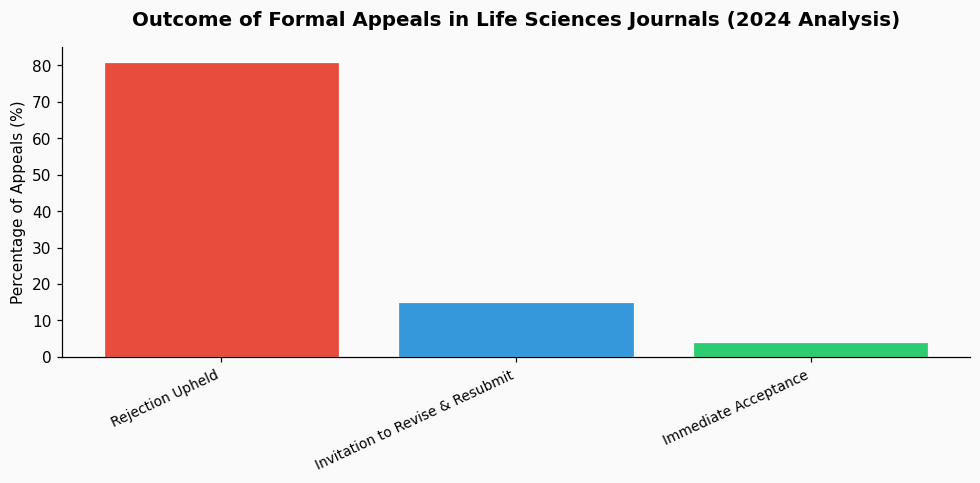
The appeal process is becoming more transparent but also more data-driven. Some journals now track appeal outcomes by editor and subject area to identify systematic biases. The rise of portable peer review and preprint commenting may create alternative paths to legitimize a paper before formal resubmission. However, practitioners should manage expectations. Even a perfectly crafted appeal is an uphill battle. Data from a 2024 analysis of 800 appeals in life sciences journals indicates that only 15% resulted in an invitation to revise and resubmit, and a mere 4% led to immediate acceptance. Your primary goal is often not reversal but a fair re-evaluation, which can sometimes mean a recommendation to submit to a different journal in the same family.
Before you appeal, conduct an honest triage. Is the journal's rejection based on a fundamental mismatch with its scope (e.g., a rare disease case report sent to a broad-phase trial journal)? If so, an appeal is futile. The more efficient path is to immediately reformat the manuscript for a more specialized journal. For example, a paper on the surgical management of hidradenocarcinoma, rejected by a general oncology journal for rarity, may be welcomed by a dermatologic surgery journal. The time invested in a detailed appeal letter is not wasted; the refined arguments and clarified text can be directly ported into your response to reviewers at the next journal, strengthening your submission. Always have a "Plan B" target journal identified before you appeal.
References & Further Reading