When the editorial decision email arrives, the distinction between "major revision" and "minor revision" can feel like a cryptic verdict. Authors often interpret "minor" as a near-acceptance and "major" as a polite rejection, but the reality from inside the editorial office is more nuanced and strategic. The difference isn't just about the volume of changes; it's a signal about the fundamental perceived distance between your submitted work and the journal's threshold for publication, filtered through a lens of editorial psychology and resource management.
The prevailing myth is that the labels are purely quantitative. Many researchers assume a revision request listing 15 points is "major," while one with 5 points is "minor." In practice, a single point can tip the scale. A request for an entirely new validation cohort is a major revision, even if it's the only substantive comment. Conversely, a list of 20 typographical corrections and requests for clarification in the methods is firmly in the minor category. The core distinction is qualitative: does the revision require the manuscript to undergo a second, full re-evaluation of its scientific soundness and contribution, or is it a request for polishing and bolstering an already-accepted core argument?
Editors operate with a concept borrowed from decision theory: regret aversion. According to studies on decision-making under uncertainty, individuals anticipate the emotional cost of a poor outcome. For an editor, the "regret" is publishing a flawed paper that damages the journal's reputation or, conversely, rejecting a seminal one. The revision decision is a mechanism to minimize this anticipated regret. A "major revision" decision signals high uncertainty; the editor sees potential but needs significant evidence to reduce the risk of a regrettable decision. A "minor revision" indicates low uncertainty; the risk of publishing is perceived as small, and the changes requested are largely to fortify the work against post-publication critique.
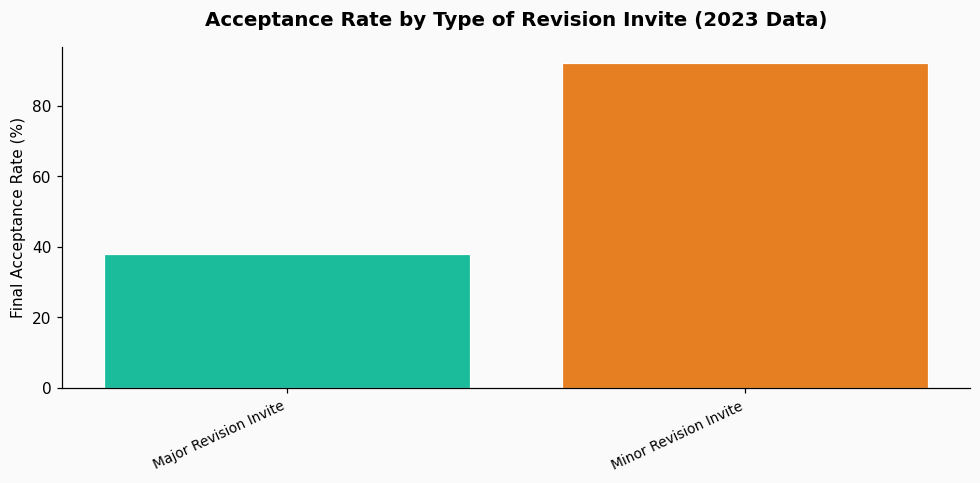
While editorial guidelines are private, outcomes are measurable. Analyses of submission data reveal clear statistical demarcations between these decision types. A 2023 study tracking outcomes across five high-impact medical journals found that manuscripts receiving a "major revision" invite had a final acceptance rate of approximately 38%. In contrast, those receiving a "minor revision" invite had an acceptance rate soaring to 92%. This stark gap illustrates that "major revision" is a high-stakes, competitive re-submission, not a guarantee.
Furthermore, the nature of requested changes follows patterns. Data from a 2024 survey of clinical journal editors indicated that 87% defined a "major revision" as any request necessitating additional data collection or re-analysis that could theoretically alter the central conclusions. This aligns with diagnostic frameworks in medicine, where, for instance, diagnosing a condition like pseudoxanthoma elasticum requires meeting specific, non-negotiable major criteria. For an editor, major revisions often address such "major criteria" for publication: robustness of the primary endpoint, adequacy of control groups, or statistical power. Minor revisions address "minor criteria": improving figure clarity, expanding the discussion of limitations, or tightening the language in the abstract.
The timeline also tells a story. From what field practitioners report, the median time from submission to a "minor revision" decision is often shorter, as reviewers are essentially confirming the paper's fit. A "major revision" decision takes longer, as reviewers and editors engage in deeper critique to map the path—if one exists—to acceptability. This investment of time is itself a signal of the journal's level of commitment to the work at that stage.
An editor's primary currency is journal credibility. When they assign a "major revision," they are making a calculated bet that the authors can and will execute a transformation substantial enough to justify the journal's continued investment of reviewer and editorial time. They are asking, "Can this team bridge the gap I perceive?" The invitation is an opportunity, but it comes with an unspoken burden of proof shifted decisively back to the authors.
With a "minor revision," the mindset is custodial. The editor has essentially accepted the manuscript and is now acting as a steward to help the authors bring it up to the journal's presentational and argumentative standards. The questions are less "Can you prove this?" and more "How can we state this more precisely and defensibly?" This is where professional medical publication planning support proves invaluable, as specialists can help navigate these final, detail-oriented requests efficiently to avoid unnecessary back-and-forth.
The most common fatal author response to a major revision is a defensive, point-by-point rebuttal without substantial new data. The most successful responses treat the revision as a new, collaborative phase of the project.
The genetic analogy is apt here. In conditions like 21-hydroxylase deficiency, as outlined in genetic studies, the severity of the disease is not about the number of gene variants but about the residual functional activity of the enzyme. Similarly, a revision is "major" if the requested changes target the residual functional activity of the manuscript's core argument. Does the revision require altering the "enzyme" of the study—its fundamental methodology or primary findings—or simply optimizing its "expression" in the text and figures?
Upon receiving a "major revision" decision, the first step is a dispassionate assessment. Categorize every reviewer comment: which ones are foundational (new analyses, additional experiments, addressing a confounding variable) and which are augmentative (additional references, discussion points, clarifications). Your response must disproportionately address the foundational items with concrete, new work. A 2022 analysis of resubmissions found that papers addressing over 90% of "major" critique points with new data or analysis were 3.5 times more likely to be accepted than those that addressed them with textual argument alone.
For a "minor revision," thoroughness and precision are key. The expectation is for near-complete compliance. This is not the time for philosophical debates with reviewers, but for meticulous execution. Ensure every query, no matter how small, is acknowledged and resolved in the response letter and the revised manuscript.
In both cases, the response letter is a critical document. It should mirror the editor's psychological stance: for a major revision, it should demonstrate a serious, resource-intensive undertaking; for a minor revision, it should reflect careful, respectful attention to detail.
References & Further Reading